763-210-9966
View Our Locations Request Appointment
02

Have you ever found yourself replaying a conversation, worrying about something that hasn’t happened yet, or analyzing the same decision over and over?

You’re not alone.

We all spend time thinking through challenges and trying to make the best decisions possible. However, sometimes our thoughts become repetitive, leaving us feeling more anxious and overwhelmed instead of helping us find solutions.

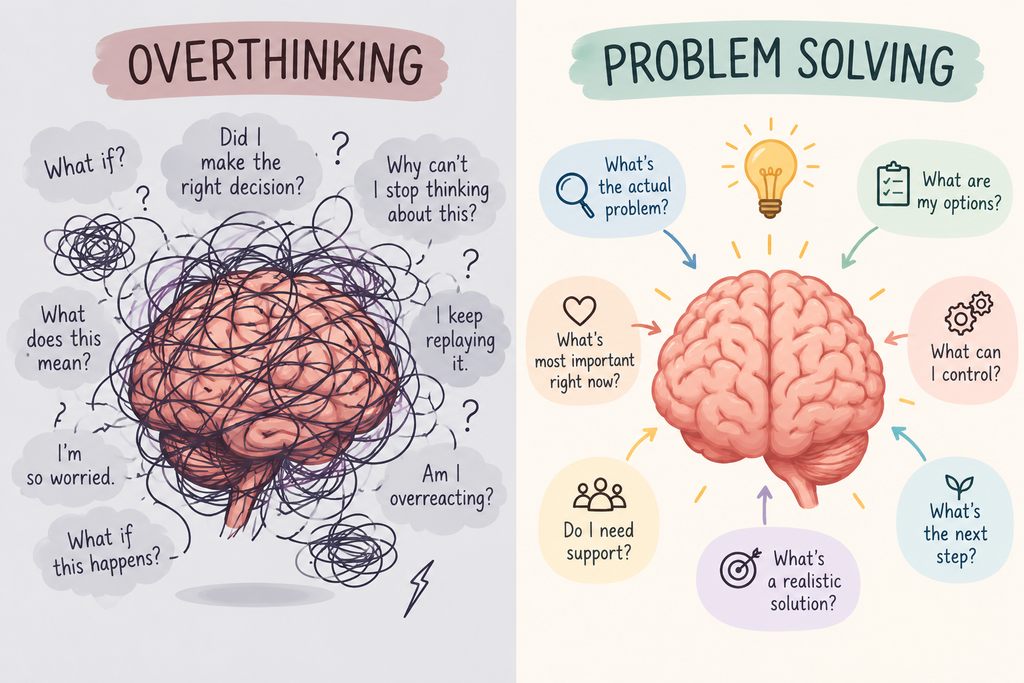
Understanding overthinking vs. problem-solving can help you recognize when your thoughts are helping you move forward and when they may be keeping you stuck.

The good news? You can learn to recognize unhelpful thought patterns and develop healthier ways to manage them.

Overthinking vs. Problem-Solving: Understanding the Difference

Although overthinking and problem-solving may seem similar, they serve different purposes.

Overthinking happens when we repeatedly analyze situations, worry about possibilities, or focus on things we cannot change. Rather than reaching a solution, we often end up feeling more stressed or uncertain.

Problem-solving, on the other hand, involves identifying a challenge, considering realistic options, and taking meaningful steps toward a solution.

For example, imagine you’re nervous about an upcoming conversation at work.

Overthinking might sound like:

“What if I say the wrong thing? What if they’re upset with me? What if everything goes badly?”

Problem-solving might sound like:

“What do I want to communicate? How can I prepare? What’s one thing I can do to feel more confident?”

The difference is whether your thoughts are helping you take action or keeping you caught in a cycle of worry.

Common Signs You’re Overthinking

Overthinking can sometimes feel productive because you’re actively thinking about a problem. However, spending more time thinking doesn’t always lead to better solutions.

Some common signs include:

  • Replaying past conversations and questioning what you said.
  • Imagining worst-case scenarios about the future.
  • Struggling to make decisions because you’re afraid of making mistakes.
  • Constantly seeking reassurance from others.
  • Feeling mentally exhausted without reaching a solution.
  • Having difficulty relaxing because your mind won’t slow down.

If these experiences sound familiar, you’re not alone. Overthinking is common, especially during stressful or uncertain times.

Recognizing these patterns is the first step toward changing how you respond to them.

Why Do We Overthink?

Overthinking isn’t simply a bad habit. In many cases, it’s our mind’s attempt to protect us from uncertainty, disappointment, or mistakes.

Several factors can contribute to overthinking, including:

  • Anxiety: Worrying about possible outcomes or situations outside your control.
  • Perfectionism: Feeling pressure to make the right decision every time.
  • Stress: Having too many responsibilities or decisions to manage.
  • Past experiences: Trying to avoid repeating difficult situations.
  • Fear of uncertainty: Wanting reassurance before moving forward.

Although these thought patterns may come from a desire to feel prepared, they can sometimes increase anxiety and emotional exhaustion.

Learning the difference between overthinking vs. problem-solving can help you approach challenges with greater confidence and clarity.

Overthinking vs. Problem-Solving: How to Recognize Each One

One of the easiest ways to identify whether you’re overthinking is to consider how your thoughts make you feel and whether they’re leading toward a helpful next step.

OverthinkingProblem-Solving
Focuses on what could go wrongFocuses on what can be done
Repeats the same worriesExplores realistic solutions
Creates more uncertaintyIdentifies possible next steps
Often increases stressProvides a sense of direction
Dwells on things outside your controlFocuses on what you can influence

A helpful question to ask yourself is:

“Am I working toward a solution, or am I going in circles?”

If you’re repeatedly thinking about the same concerns without making progress, it may be time to try a different approach.

5 Ways to Stop Overthinking and Start Problem-Solving

You don’t have to eliminate every anxious thought to feel better. Instead, focus on developing healthier ways to respond when your mind becomes overwhelmed.

1. Focus on What You Can Control

Overthinking often involves worrying about situations we cannot fully control.

For example, you can’t control someone else’s reaction, predict the future, or change something that already happened.

However, you can control how you respond, what boundaries you set, and what steps you take next.

When you notice yourself worrying, ask:

“Is this something I can influence right now?”

If the answer is yes, identify one small action you can take. If the answer is no, practice redirecting your attention toward something within your control.

2. Let Go of the Need for Perfect Decisions

Many people struggle with overthinking because they want to avoid making mistakes.

However, most decisions don’t come with complete certainty.

Instead of asking, “What if I make the wrong choice?” try asking:

“What’s a reasonable decision based on what I know right now?”

Remember, making progress doesn’t require having every answer.

3. Set Aside Time to Work Through Your Worries

When anxious thoughts keep repeating, consider setting aside a specific amount of time to think through your concerns.

For example, spend 10–15 minutes writing down what’s bothering you.

Then ask yourself:

  • What is the actual problem?
  • What possible solutions are available?
  • Is there a step I can take today?
  • What might I need to accept or revisit later?

Once that time is up, practice shifting your attention toward another activity.

This approach can help create healthier boundaries around worry without ignoring your emotions.

4. Take One Small Step Forward

Overthinking can make even simple decisions feel overwhelming.

Rather than trying to solve everything at once, focus on one manageable action.

That might mean sending an email, scheduling an appointment, having a conversation, or creating a plan.

Taking small steps can help you feel more capable and less stuck.

Remember: Progress doesn’t have to be perfect to be meaningful.

5. Practice Mindfulness and Staying Present

Overthinking often pulls our attention toward past experiences or future possibilities.

Mindfulness can help bring your attention back to the present moment.

Try taking a few slow breaths, going for a walk, journaling, or noticing the sights and sounds around you.

These activities won’t necessarily eliminate anxious thoughts. However, they can help you create space between having a thought and reacting to it.

Over time, practicing mindfulness may help you respond to stressful situations with greater awareness.

How Overthinking Can Affect Your Mental Health

Occasional overthinking is a normal part of life. However, when repetitive thoughts become persistent, they can affect your emotional well-being.

Overthinking may contribute to:

  • Increased stress and anxiety.
  • Difficulty falling or staying asleep.
  • Trouble concentrating or making decisions.
  • Feeling emotionally exhausted.
  • Increased self-doubt.
  • Difficulty enjoying the present moment.

Additionally, ongoing worry can sometimes be associated with anxiety, depression, or other mental health concerns.

If overthinking begins interfering with your daily activities, relationships, or quality of life, talking with a mental health professional may be helpful.

For additional information about anxiety, visit the National Institute of Mental Health.

Can Therapy Help With Overthinking?

Yes! Therapy can provide a supportive space to better understand your thoughts, identify patterns, and develop practical coping strategies.

At Collaborative Counseling, our therapists work with individuals experiencing anxiety, stress, perfectionism, life transitions, and other challenges that may contribute to overthinking.

Depending on your needs, approaches such as Cognitive Behavioral Therapy (CBT) and Acceptance and Commitment Therapy (ACT) may help you:

  • Recognize unhelpful thought patterns.
  • Develop healthier responses to anxious thoughts.
  • Build confidence in decision-making.
  • Learn to tolerate uncertainty.
  • Practice mindfulness and emotional regulation.
  • Focus on meaningful actions instead of repetitive worry.

Therapy isn’t about learning to never worry again. Instead, it’s about building the tools to manage difficult thoughts in ways that support your mental health.

You can learn more about our therapy services at Collaborative Counseling.

Moving Forward: Finding Balance Between Thinking and Doing

Understanding overthinking vs. problem-solving is an important step toward developing healthier thinking habits.

It’s okay not to have every answer. It’s okay to make decisions without knowing exactly how things will turn out. And it’s okay to ask for help when your thoughts feel overwhelming.

The next time you find yourself caught in a cycle of worry, consider asking:

“Is this thought helping me move forward, or is it keeping me stuck?”

Sometimes, the most helpful thing you can do is take one small step, practice self-compassion, and give yourself permission to let go of what you cannot control.

You Don’t Have to Navigate Overthinking Alone

At Collaborative Counseling, we understand how exhausting it can feel when your mind won’t slow down.

Our compassionate therapists are here to help you navigate anxiety, stress, and life’s uncertainties while developing healthier coping strategies.

We offer in-person and telehealth therapy throughout Minnesota and Wisconsin, proudly serving our clinic communities and surrounding areas.

Ready to take the next step?

Visit www.collaborativemn.com to learn more or schedule an appointment.

Collaborative Counseling | 763-210-9966

Read More


October is ADHD Awareness Month! While many people associate Attention-Deficit/Hyperactivity Disorder (ADHD) with children who struggle to sit still or pay attention in school, ADHD is much more complex than that. It can affect people of all ages, and the symptoms aren’t always what you might expect.

In fact, many adults live with ADHD for years without realizing it. Understanding how ADHD presents differently in children and adults can help reduce stigma, encourage earlier recognition, and connect people with the support they need.

What Is ADHD?

Attention-Deficit/Hyperactivity Disorder (ADHD) is a neurodevelopmental condition that affects how the brain regulates attention, impulses, and activity levels.

But here’s something that often surprises people: Having ADHD doesn’t necessarily mean you can’t pay attention. Many individuals with ADHD can become deeply focused on activities they find interesting while struggling to maintain attention on tasks that feel repetitive or less engaging.

ADHD also affects executive functioning, which includes the mental skills we use to plan, organize, manage time, regulate emotions, and complete everyday tasks.

ADHD is generally categorized into three presentations:

  • Predominantly Inattentive: Difficulty sustaining attention, staying organized, following through on tasks, or remembering important details.
  • Predominantly Hyperactive-Impulsive: Restlessness, excessive talking, difficulty waiting, or acting without thinking.
  • Combined Presentation: A combination of inattentive and hyperactive-impulsive symptoms.

These symptoms can change throughout a person’s life, meaning ADHD may look very different in adulthood than it did during childhood.

ADHD in Children: It’s Not Always the Child Who Can’t Sit Still

When people picture a child with ADHD, they often imagine someone who is constantly moving, interrupting others, or struggling to follow directions.

While those behaviors can certainly be signs of ADHD, they don’t tell the whole story.

Some children with ADHD are quiet, daydream frequently, or appear to be listening while struggling to process and retain information.

Common signs of ADHD in children include:

  • Difficulty following multi-step directions
  • Frequently losing school supplies, homework, or personal belongings
  • Trouble completing assignments despite understanding the material
  • Becoming easily distracted or appearing to daydream
  • Difficulty waiting their turn or interrupting conversations
  • Struggling with transitions between activities
  • Having difficulty managing frustration or strong emotions
  • Forgetting responsibilities or needing frequent reminders

ADHD Can Look Different in Girls and Boys

ADHD is often recognized earlier in boys, partly because hyperactive and impulsive behaviors may be more noticeable in classroom settings.

Girls with ADHD may be more likely to demonstrate inattentive symptoms, such as daydreaming, disorganization, or difficulty maintaining focus. However, ADHD can present in any of these ways regardless of gender.

Some children work incredibly hard to compensate for their challenges, making their symptoms less obvious to teachers and parents.

A child who appears quiet, cooperative, or academically successful can still have ADHD.

This is one reason understanding the less obvious symptoms is so important.

ADHD in Adults: When Everyday Life Feels Overwhelming

ADHD doesn’t simply disappear when someone turns 18.

For many adults, symptoms continue into adulthood, although they may look different as responsibilities and expectations change.

The child who struggled to sit still may become an adult who feels internally restless, constantly multitasks, or has difficulty relaxing.

The child who frequently forgot homework may become an adult who misses appointments, struggles with deadlines, or feels overwhelmed managing household responsibilities.

Common signs of ADHD in adults include:

  • Chronic procrastination, even with important tasks
  • Difficulty starting or completing projects
  • Frequently misplacing keys, phones, or other belongings
  • Feeling overwhelmed by everyday responsibilities
  • Difficulty managing time or consistently running late
  • Trouble prioritizing tasks and staying organized
  • Impulsive spending or decision-making
  • Difficulty maintaining focus during conversations
  • Feeling mentally restless or unable to relax
  • Experiencing frustration when managing multiple responsibilities

The Emotional Side of ADHD

One aspect of ADHD that doesn’t receive enough attention is its impact on emotional well-being.

Some individuals with ADHD experience difficulties regulating emotions, managing frustration, or recovering from stressful situations.

Over time, these challenges can contribute to feelings of inadequacy, anxiety, low self-esteem, or burnout.

Adults with undiagnosed ADHD may spend years believing they are simply disorganized, unmotivated, or not trying hard enough.

But ADHD isn’t a character flaw or a lack of effort. It involves differences in how the brain manages attention, behavior, and executive functioning.

Understanding those differences can be an important step toward developing effective strategies and building self-compassion.

Why ADHD Is Sometimes Missed Until Adulthood

Many people are surprised to receive an ADHD diagnosis as adults, particularly if they performed well academically or didn’t demonstrate obvious behavioral challenges as children.

There are several reasons ADHD may go unrecognized:

1. Symptoms weren’t disruptive.
Children with predominantly inattentive symptoms may not attract attention because they aren’t interrupting class or displaying hyperactive behaviors.

2. Strong coping skills masked the challenges.
Some individuals develop elaborate routines, rely heavily on reminders, or work significantly harder to compensate for difficulties with organization and attention.

3. Symptoms were attributed to something else.
Difficulty concentrating, procrastination, or emotional struggles may be mistaken for anxiety, depression, stress, or personality traits. These conditions can also occur alongside ADHD.

4. Adult responsibilities made symptoms more noticeable.
As life becomes more complex, managing work, relationships, finances, parenting, and household responsibilities can place greater demands on executive functioning.

Someone who managed their symptoms successfully in school may begin struggling when those external structures and supports disappear.

ADHD Is More Than a Challenge — Understanding Strengths Matters, Too

While ADHD can create meaningful challenges, it’s important to recognize that individuals with ADHD also bring unique strengths, perspectives, and abilities.

Some people with ADHD describe themselves as creative thinkers, enthusiastic problem-solvers, adaptable, or highly engaged when working on something meaningful to them.

Not everyone with ADHD experiences these characteristics, but recognizing individual strengths can help shift the conversation away from focusing exclusively on difficulties.

The goal of understanding ADHD isn’t to change who someone is. It’s to help them better understand how they function and develop strategies that support their success.

When Should You Consider Seeking Support?

Everyone occasionally forgets appointments, procrastinates, or struggles to concentrate.

However, when these challenges are persistent, began during childhood, occur across multiple settings, and interfere with everyday functioning, it may be worth exploring whether ADHD could be contributing.

For children, this might mean ongoing difficulties with schoolwork, friendships, emotional regulation, or family routines.

For adults, it may involve challenges with work performance, relationships, household responsibilities, or managing daily life.

A comprehensive ADHD evaluation can help determine whether symptoms are related to ADHD or another condition with overlapping characteristics.

An accurate diagnosis can provide clarity, but support doesn’t have to wait until everything has a label.

Therapy can help individuals develop practical strategies for managing executive functioning challenges, emotional regulation, stress, and self-esteem.

How Therapy Can Help Individuals With ADHD

ADHD support isn’t one-size-fits-all. What works for one person may not work for another.

Therapy can help children, adolescents, and adults better understand their challenges and develop skills that make everyday life more manageable.

Depending on individual needs, therapy may focus on:

  • Building organizational and time-management strategies
  • Improving emotional regulation and coping skills
  • Developing routines and realistic expectations
  • Addressing anxiety, depression, or low self-esteem
  • Strengthening communication and relationships
  • Helping parents better understand and support children with ADHD
  • Reducing stress and frustration associated with executive functioning difficulties

For some individuals, medication may also be an important component of treatment. A qualified medical professional can help determine whether medication is appropriate.

The most effective approach is one that considers the whole person, not just their symptoms.

Understanding ADHD Starts With Awareness

This October, during ADHD Awareness Month, we encourage you to look beyond the stereotypes.

ADHD isn’t always the child bouncing out of their seat. Sometimes it’s the quiet student who can’t keep track of assignments.

It isn’t always the adult who can’t focus. Sometimes it’s the parent who feels overwhelmed by everyday responsibilities or the professional who works twice as hard to stay organized.

ADHD looks different for everyone, and understanding those differences can make a meaningful impact.

Whether you’re navigating ADHD yourself, supporting a child, or wondering whether ADHD may explain challenges you’ve experienced, you deserve understanding, compassion, and support.

We’re Here to Help

At Collaborative Counseling, our compassionate therapists work with children, adolescents, and adults navigating ADHD and related mental health challenges.

We offer individual and family counseling, with convenient in-person and telehealth appointments throughout Minnesota and Wisconsin.

💙 We currently have immediate openings and are in-network with many major insurance plans!

Taking the first step toward understanding yourself or supporting someone you love can make a meaningful difference.

Visit www.collaborativemn.com to learn more or schedule an appointment.

Read More

28
Is My Child’s Anxiety Normal? When to Seek Therapy in MN/WI

It’s normal for children to worry sometimes.

They may feel nervous before a test, anxious about a new school year, scared during storms, or clingy during transitions. But how do you know when anxiety is typical—and when it may be time to seek child anxiety therapy in MN/WI?

Many parents struggle with this question. The goal isn’t to eliminate all anxiety. Anxiety is a natural and protective emotion. The key is recognizing when it becomes excessive, persistent, or disruptive.

What Normal Childhood Anxiety Looks Like

Typical anxiety in children is:

• Temporary
• Connected to a specific situation
• Age-appropriate
• Manageable with reassurance
• Not significantly interfering with daily life

For example, it’s common for young children to experience separation anxiety or for older children to feel nervous about social situations.

Most of the time, these worries come and go.

Signs Anxiety May Be More Than “Normal”

It may be time to consider child anxiety therapy MN/WI if your child’s anxiety:

• Lasts for weeks or months
• Interferes with school attendance or performance
• Causes frequent stomachaches or headaches
• Leads to sleep disturbances
• Triggers emotional outbursts or shutdowns
• Prevents participation in activities they once enjoyed
• Causes excessive reassurance-seeking
• Results in avoidance behaviors

When anxiety begins to limit your child’s world, support can help.

How Anxiety Shows Up Differently in Children

Children don’t always say, “I feel anxious.”

Instead, anxiety may appear as:

• Irritability
• Meltdowns
• Perfectionism
• Frequent “what if” questions
• Physical complaints
• Refusal to go to school
• Clinginess
• Difficulty sleeping alone

You may notice patterns of fear that seem bigger than the situation warrants.

Common Types of Childhood Anxiety

Children may experience:

• Separation anxiety
• Social anxiety
• Generalized anxiety
• Specific phobias
• School-related anxiety
• Performance anxiety

Early support can prevent anxiety from becoming more entrenched over time.

When to Seek Child Anxiety Therapy in MN/WI

You don’t have to wait for a crisis.

Consider reaching out if:

• Your child seems stuck in worry
• You feel unsure how to help
• Reassurance no longer works
• Anxiety is affecting family routines
• You notice increasing avoidance

Therapy works best when started early.

How Child Anxiety Therapy Helps

Child anxiety therapy MN/WI focuses on teaching coping skills—not just talking about fears.

In therapy, children learn to:

• Identify and name their feelings
• Understand how anxiety works in the body
• Practice calming strategies
• Challenge fearful thinking
• Build confidence gradually
• Increase emotional regulation

Therapists often involve parents in the process so you feel equipped to support your child at home.

Supporting an Anxious Child at Home

Parents can help by:

• Validating feelings without amplifying fear
• Encouraging gradual exposure instead of avoidance
• Maintaining predictable routines
• Modeling calm coping skills
• Avoiding excessive reassurance cycles

The goal is not to remove discomfort—but to build resilience.

Child Anxiety Therapy in Minnesota & Wisconsin

At Collaborative Counseling, we provide evidence-based child anxiety therapy MN/WI to support children and families navigating anxiety, school stress, social fears, and emotional overwhelm.

We offer:

📍 In-person therapy at:
Chanhassen • Maple Grove • Roseville • Osseo • Lakeville • Northfield (MN)
Hudson • Eau Claire (Oakwood & Clairemont) (WI)

💻 Telehealth therapy statewide in Minnesota & Wisconsin

You Don’t Have to Guess

If you’re asking whether your child’s anxiety is normal, that’s already a sign you’re paying attention.

Trust your instincts. Early support builds long-term resilience.

📅 Schedule a child therapy session today:
https://www.collaborativemn.com/appointment-request

Helping your child feel steady now supports their future confidence. 💙

Read More