
 View Our Locations
 Request Appointment
Overthinking vs. Problem-Solving: What’s the Difference?
Posted by Collaborative Counseling
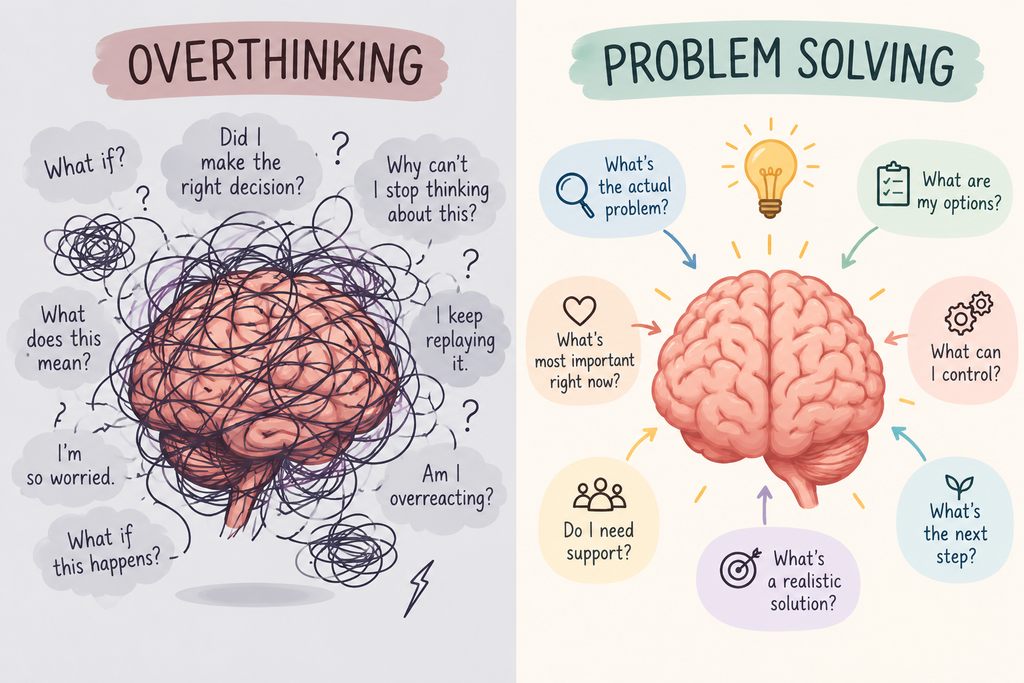
Have you ever found yourself replaying a conversation, worrying about something that hasn’t happened yet, or analyzing the same decision over and over?
You’re not alone.
We all spend time thinking through challenges and trying to make the best decisions possible. However, sometimes our thoughts become repetitive, leaving us feeling more anxious and overwhelmed instead of helping us find solutions.
Understanding overthinking vs. problem-solving can help you recognize when your thoughts are helping you move forward and when they may be keeping you stuck.
The good news? You can learn to recognize unhelpful thought patterns and develop healthier ways to manage them.
Overthinking vs. Problem-Solving: Understanding the Difference
Although overthinking and problem-solving may seem similar, they serve different purposes.
Overthinking happens when we repeatedly analyze situations, worry about possibilities, or focus on things we cannot change. Rather than reaching a solution, we often end up feeling more stressed or uncertain.
Problem-solving, on the other hand, involves identifying a challenge, considering realistic options, and taking meaningful steps toward a solution.
For example, imagine you’re nervous about an upcoming conversation at work.
Overthinking might sound like:
“What if I say the wrong thing? What if they’re upset with me? What if everything goes badly?”
Problem-solving might sound like:
“What do I want to communicate? How can I prepare? What’s one thing I can do to feel more confident?”
The difference is whether your thoughts are helping you take action or keeping you caught in a cycle of worry.
Common Signs You’re Overthinking
Overthinking can sometimes feel productive because you’re actively thinking about a problem. However, spending more time thinking doesn’t always lead to better solutions.
Some common signs include:
- Replaying past conversations and questioning what you said.
- Imagining worst-case scenarios about the future.
- Struggling to make decisions because you’re afraid of making mistakes.
- Constantly seeking reassurance from others.
- Feeling mentally exhausted without reaching a solution.
- Having difficulty relaxing because your mind won’t slow down.
If these experiences sound familiar, you’re not alone. Overthinking is common, especially during stressful or uncertain times.
Recognizing these patterns is the first step toward changing how you respond to them.
Why Do We Overthink?
Overthinking isn’t simply a bad habit. In many cases, it’s our mind’s attempt to protect us from uncertainty, disappointment, or mistakes.
Several factors can contribute to overthinking, including:
- Anxiety: Worrying about possible outcomes or situations outside your control.
- Perfectionism: Feeling pressure to make the right decision every time.
- Stress: Having too many responsibilities or decisions to manage.
- Past experiences: Trying to avoid repeating difficult situations.
- Fear of uncertainty: Wanting reassurance before moving forward.
Although these thought patterns may come from a desire to feel prepared, they can sometimes increase anxiety and emotional exhaustion.
Learning the difference between overthinking vs. problem-solving can help you approach challenges with greater confidence and clarity.
Overthinking vs. Problem-Solving: How to Recognize Each One
One of the easiest ways to identify whether you’re overthinking is to consider how your thoughts make you feel and whether they’re leading toward a helpful next step.
| Overthinking | Problem-Solving |
|---|---|
| Focuses on what could go wrong | Focuses on what can be done |
| Repeats the same worries | Explores realistic solutions |
| Creates more uncertainty | Identifies possible next steps |
| Often increases stress | Provides a sense of direction |
| Dwells on things outside your control | Focuses on what you can influence |
A helpful question to ask yourself is:
“Am I working toward a solution, or am I going in circles?”
If you’re repeatedly thinking about the same concerns without making progress, it may be time to try a different approach.
5 Ways to Stop Overthinking and Start Problem-Solving
You don’t have to eliminate every anxious thought to feel better. Instead, focus on developing healthier ways to respond when your mind becomes overwhelmed.
1. Focus on What You Can Control
Overthinking often involves worrying about situations we cannot fully control.
For example, you can’t control someone else’s reaction, predict the future, or change something that already happened.
However, you can control how you respond, what boundaries you set, and what steps you take next.
When you notice yourself worrying, ask:
“Is this something I can influence right now?”
If the answer is yes, identify one small action you can take. If the answer is no, practice redirecting your attention toward something within your control.
2. Let Go of the Need for Perfect Decisions
Many people struggle with overthinking because they want to avoid making mistakes.
However, most decisions don’t come with complete certainty.
Instead of asking, “What if I make the wrong choice?” try asking:
“What’s a reasonable decision based on what I know right now?”
Remember, making progress doesn’t require having every answer.
3. Set Aside Time to Work Through Your Worries
When anxious thoughts keep repeating, consider setting aside a specific amount of time to think through your concerns.
For example, spend 10–15 minutes writing down what’s bothering you.
Then ask yourself:
- What is the actual problem?
- What possible solutions are available?
- Is there a step I can take today?
- What might I need to accept or revisit later?
Once that time is up, practice shifting your attention toward another activity.
This approach can help create healthier boundaries around worry without ignoring your emotions.
4. Take One Small Step Forward
Overthinking can make even simple decisions feel overwhelming.
Rather than trying to solve everything at once, focus on one manageable action.
That might mean sending an email, scheduling an appointment, having a conversation, or creating a plan.
Taking small steps can help you feel more capable and less stuck.
Remember: Progress doesn’t have to be perfect to be meaningful.
5. Practice Mindfulness and Staying Present
Overthinking often pulls our attention toward past experiences or future possibilities.
Mindfulness can help bring your attention back to the present moment.
Try taking a few slow breaths, going for a walk, journaling, or noticing the sights and sounds around you.
These activities won’t necessarily eliminate anxious thoughts. However, they can help you create space between having a thought and reacting to it.
Over time, practicing mindfulness may help you respond to stressful situations with greater awareness.
How Overthinking Can Affect Your Mental Health
Occasional overthinking is a normal part of life. However, when repetitive thoughts become persistent, they can affect your emotional well-being.
Overthinking may contribute to:
- Increased stress and anxiety.
- Difficulty falling or staying asleep.
- Trouble concentrating or making decisions.
- Feeling emotionally exhausted.
- Increased self-doubt.
- Difficulty enjoying the present moment.
Additionally, ongoing worry can sometimes be associated with anxiety, depression, or other mental health concerns.
If overthinking begins interfering with your daily activities, relationships, or quality of life, talking with a mental health professional may be helpful.
For additional information about anxiety, visit the National Institute of Mental Health.
Can Therapy Help With Overthinking?
Yes! Therapy can provide a supportive space to better understand your thoughts, identify patterns, and develop practical coping strategies.
At Collaborative Counseling, our therapists work with individuals experiencing anxiety, stress, perfectionism, life transitions, and other challenges that may contribute to overthinking.
Depending on your needs, approaches such as Cognitive Behavioral Therapy (CBT) and Acceptance and Commitment Therapy (ACT) may help you:
- Recognize unhelpful thought patterns.
- Develop healthier responses to anxious thoughts.
- Build confidence in decision-making.
- Learn to tolerate uncertainty.
- Practice mindfulness and emotional regulation.
- Focus on meaningful actions instead of repetitive worry.
Therapy isn’t about learning to never worry again. Instead, it’s about building the tools to manage difficult thoughts in ways that support your mental health.
You can learn more about our therapy services at Collaborative Counseling.
Moving Forward: Finding Balance Between Thinking and Doing
Understanding overthinking vs. problem-solving is an important step toward developing healthier thinking habits.
It’s okay not to have every answer. It’s okay to make decisions without knowing exactly how things will turn out. And it’s okay to ask for help when your thoughts feel overwhelming.
The next time you find yourself caught in a cycle of worry, consider asking:
“Is this thought helping me move forward, or is it keeping me stuck?”
Sometimes, the most helpful thing you can do is take one small step, practice self-compassion, and give yourself permission to let go of what you cannot control.
You Don’t Have to Navigate Overthinking Alone
At Collaborative Counseling, we understand how exhausting it can feel when your mind won’t slow down.
Our compassionate therapists are here to help you navigate anxiety, stress, and life’s uncertainties while developing healthier coping strategies.
We offer in-person and telehealth therapy throughout Minnesota and Wisconsin, proudly serving our clinic communities and surrounding areas.
Ready to take the next step?
Visit www.collaborativemn.com to learn more or schedule an appointment.
Collaborative Counseling | 763-210-9966
Read More


 Patient Portal
 View Our Locations
 Request Appointment