763-210-9966
View Our Locations Request Appointment
22
Self care, biking, running, meditate

Self-care is important for everyone, but it can be especially difficult to make time for when you’re on a budget. Taking care of yourself is an investment in your health and well-being, and it’s worth it to make time for it, even if you’re on a budget. Here are 20 budget-friendly self-care ides that can help you take care of yourself without breaking the bank:

  1. Take a walk. Going for a walk is a great way to get some exercise and fresh air, both of which are beneficial for your physical and mental health. And, it’s free!
  2. Read a book. Curling up with a good book is a great way to relax and escape from the stresses of everyday life. If you don’t have a lot of money to spend on books, check out your local library or bookshop for used books.
  3. Listen to music. Listening to music can help to improve your mood and reduce stress. Create a playlist of your favorite songs or listen to a new album.
  4. Take a bath. Adding some essential oils to your bath can help to create a relaxing atmosphere. You can also add some bath salts or bubbles for an extra treat.
  5. Get a massage. If you can afford it, a massage is a great way to relax and de-stress. However, there are also many ways to give yourself a massage at home. Try using a tennis ball or rolling pin to massage your muscles.
  6. Meditate. Meditation is a great way to reduce stress and improve your focus. There are many different types of meditation, so find one that works for you.
  7. Yoga. Yoga is a great way to improve your flexibility, strength, and balance. It can also help to reduce stress and improve your mood.
  8. Spend time in nature. Spending time in nature has been shown to have a number of benefits for your physical and mental health. Go for a walk in the park, hike in the woods, or just sit in your backyard and enjoy the fresh air.
  9. Get enough sleep. When you’re well-rested, you’re better able to handle stress and make good decisions. Aim for 7-8 hours of sleep per night.
  10. Eat healthy foods. Eating healthy foods gives you the energy you need to feel your best. Make sure to include plenty of fruits, vegetables, and whole grains in your diet.
  11. Drink plenty of water. Staying hydrated is important for your physical and mental health. Aim to drink 8 glasses of water per day.
  12. Get regular exercise. Exercise is a great way to reduce stress, improve your mood, and boost your energy levels. Aim for at least 30 minutes of moderate-intensity exercise most days of the week.
  13. Spend time with loved ones. Social connection is important for your mental health. Make time for the people who matter most to you.
  14. Do something you enjoy. Whether it’s reading, painting, or playing music, make time for something that you enjoy doing. This will help you to relax and de-stress.
  15. Set boundaries. It’s important to set boundaries between work and personal time. Make sure to take some time for yourself each day to relax and recharge.
  16. Say no. It’s okay to say no to things that you don’t have time for or that you don’t want to do. Don’t feel guilty about putting your own needs first.
  17. Take care of your mental health. If you’re struggling with your mental health, don’t hesitate to seek professional help. A therapist can help you to develop coping mechanisms and strategies for dealing with stress.
  18. Be kind to yourself. It’s important to be kind to yourself, even when you make mistakes. Forgive yourself and move on.
  19. Take a break from social media. Social media can be a great way to stay connected with friends and family, but it can also be a major source of stress. Take a break from social media every now and then to clear your head and relax.
  20. Do something nice for someone else. Doing something nice for someone else can help to improve your mood and make you feel good about yourself. Volunteer your time, donate to a charity, or simply do a kind act for a stranger.

These are just a few ideas for budget-friendly self-care. The most important thing is to find activities that you enjoy and that help you to relax and de-stress.

Read More


19

The Importance of Fathers

Posted by Sam McManigle
Showing Love to Your Kids with the 5 Love Languages

Father’s Day is a special day to celebrate all the fathers in our lives. It is a time to show our appreciation for their love, support, and guidance. Fathers play a vital role in the development of their children, and their influence can be felt for a lifetime. The importance of fathers cannot be overstated.

Here are some of the reasons why fathers are so important:

  • They provide love and support. Fathers are a source of love and support for their children. They are there to comfort them when they are sad, to cheer them on when they are happy, and to help them through tough times.
  • They teach their children important life skills. Fathers teach their children important life skills, such as how to be responsible, how to work hard, and how to be kind and compassionate. They also help their children develop their talents and interests.
  • They serve as role models. Fathers serve as role models for their children. They teach their children what it means to be a man, a husband, and a father. They also show their children how to be responsible, how to work hard, and how to be kind and compassionate.

Fathers play a vital role in the development of their children, and their influence can be felt for a lifetime. On this Father’s Day, let us all take a moment to thank our fathers for all that they do.

Here are some specific ways that fathers can positively impact their children’s lives:

  • Be present. The most important thing that a father can do for his children is to be present in their lives. This means spending time with them, listening to them, and being involved in their activities.
  • Be a role model. Children learn by watching the adults in their lives. If a father wants his children to be kind, compassionate, and responsible, he needs to model those qualities himself.
  • Set high expectations. Fathers should set high expectations for their children. This doesn’t mean that they need to be perfect, but they should expect their children to work hard, do their best, and be respectful of others.
  • Be supportive. Fathers should be supportive of their children’s dreams and goals. They should encourage them to follow their passions and to never give up on their dreams.
  • Be patient. Parenting is a journey, and it’s important to be patient with yourself and your children. There will be ups and downs, but if you’re patient and loving, you’ll get through them together.

Fathers play a vital role in the lives of their children. By being present, being a role model, setting high expectations, being supportive, and being patient, fathers can help their children grow into happy, healthy, and successful adults.

How to Celebrate Father’s Day There are many ways to celebrate.

Here are a few ideas:

  • Spend time together. The best way to celebrate Father’s Day is to spend time with your father. Go on a hike, play catch, or just sit and talk.
  • Give him a gift. A gift doesn’t have to be expensive. A homemade card, a framed photo, or a gift certificate to his favorite store will show him how much you care.
  • Make him a meal. Cooking dinner for your father is a great way to show him how much you appreciate him. He’ll love a home-cooked meal, especially if it’s his favorite dish.
  • Write him a letter. A letter is a personal way to express your love and appreciation for your father. Tell him how much he means to you and why you’re so grateful to have him in your life.
  • Take him out to his favorite place. If your father has a favorite restaurant or activity, take him out to enjoy it. He’ll love spending time with you and doing something he enjoys.

Overall no matter how you choose to celebrate Father’s Day, make sure to let your father know how much you love and appreciate him. He deserves it!

Read More
18

Helping others improves your mental health

Posted by Collaborative Counseling
Helping others

Helping others can be altruistic and also helping others can be a way to improve your mental health. Helping others improves your mental health and well being. We all have those days when we’re feeling down. Maybe we had a bad day at work, or maybe we’re just feeling stressed out about life in general. On those days, it can be really helpful to have a little bit of kindness from a stranger. Even a small act of kindness can make a big difference in someone’s day.

Here are 20 ways to brighten a stranger’s day

  • Pay them a compliment.
  • Hold the door open for them.
  • Let them go ahead of you in line.
  • Give them your seat on the bus or train.
  • Help them carry their groceries.
  • Pay for their coffee or meal.
  • Give them a flower.
  • Write them a thank-you note.
  • Smile at them.
  • Listen to them.
  • Offer to help them with something.
  • Give them a compliment on their work.
  • Give them a gift.
  • Volunteer your time.
  • Be kind to animals.
  • Be patient.
  • Be forgiving.
  • Be positive.
  • Be grateful.
  • Just be kind.

These are just a few ideas for ways to brighten a stranger’s day. There are many other ways to show kindness to others. The important thing is to be mindful of the people around you and to look for opportunities to make a difference. Even a small act of kindness can make a big difference in someone’s day.

Here are some ways that helping others can improve mental health

  • Reduce stress: Helping others can take your mind off of your own problems and give you a sense of purpose. This can help to reduce stress and anxiety.
  • Increase self-esteem: When you help others, it can make you feel good about yourself and your abilities. This can help to improve your self-esteem.
  • Build relationships: Helping others can help you to connect with others and build strong relationships. This can provide you with social support, which can be helpful for mental health.
  • Feel connected to something bigger than yourself: Helping others can help you to feel like you are part of something bigger than yourself. This can give you a sense of purpose and meaning in life, which can be helpful for mental health.

Acts of kindness help everyone

These acts of kindness can also have a positive impact on the mental health of the person doing the helping.

For example, when you pay someone a compliment, it can make them feel good about themselves. This can boost their self-esteem and make them feel more confident. When you hold the door open for someone, it shows that you are considerate of others. This can make them feel appreciated and valued. When you let someone go ahead of you in line, it shows that you are patient and understanding. This can make them feel less stressed and more relaxed.

All of these acts of kindness can have a positive impact on the mental health of the person doing the helping. They can reduce stress, increase self-esteem, build relationships, and make people feel more connected to something bigger than themselves. To learn more about ways to boost your self esteem, visit our page on self esteem by clicking here!

If you are looking for ways to improve your own mental health, consider finding ways to help others. It’s a win-win for everyone involved. Helping others improves your mental health and theirs!

Read More
10

A Closer Look at Anxiety

Posted by Collaborative Counseling
What your emotions are trying to tell you?

Anxiety disorders are one of the most common mental health issues people face. While it is common, there is still some misunderstanding about what anxiety can look like. Lets take a closer look.

What is Anxiety?

Anxiety is a general term that refers to many disorders such as generalized anxiety disorder, panic disorder & panic attacks, separation anxiety and specific phobias (e.g. germs, flying, driving etc.). All of the disorders categorized under Anxiety, share the concept of excessive fear that results in a behavioral and functional disturbance. Excessive fear can refer to an emotional response to either a perceived threat or anticipation of a future threat. Panic attacks are an example of a fear response.

It is important to note that anxiety is a normal part of life. However, when anxiety interferes with daily activities due to overwhelming and persistent worry, you may have an anxiety disorder.

Risk Factors

There are several risk factors for developing anxiety. Major ones include:

  • Genetics: Anxiety has a hereditary risk factor as it can run in families.
  • Environmental Factors: Parenting behaviors such as being controlling or exhibiting anxious behavior can be risk factors for children.
  • Personality: Those who are introverted and less conscientious may be at risk for an anxiety disorder
  • Gender: Women are more likely than men to develop anxiety.

Treatments for Anxiety Disorders

There are many different forms of therapy and treatment for anxiety. Some of the most common include:

  • Cognitive behavioral therapy (CBT) is a type of therapy that focuses on changing the way you think and behave. CBT can help you identify and challenge negative thoughts and beliefs that contribute to your anxiety, and learn new coping skills to manage your anxiety symptoms. Learn more about CBT in this article: APA – What is Cognitive Behavioral Therapy?
  • Exposure therapy is a type of therapy that involves gradually exposing you to the things or situations that make you anxious. This can help you learn to manage your anxiety and cope with your fears.
  • Acceptance and commitment therapy (ACT) is a type of therapy that focuses on helping you accept your anxiety and commit to living a meaningful life despite your fears.
  • Dialectical behavioral therapy (DBT) is a type of therapy that combines CBT, mindfulness, and acceptance skills to help you manage your emotions and cope with difficult situations.
  • Interpersonal therapy (IPT) is a type of therapy that focuses on your relationships with others. IPT can help you improve your communication skills, resolve conflict, and build stronger relationships.

In addition to therapy, there are also a number of medications that can be used to treat anxiety. These medications work by changing the way your brain functions, and can help to reduce your anxiety symptoms.

However, if you are struggling with anxiety, it is important to seek professional help. A therapist or doctor can help you develop a treatment plan that is right for you.

Steps you can take to get help for anxiety disorders

    • Talk to your doctor. Your doctor can refer you to a therapist or counselor who specializes in anxiety disorders.
    • Do your research. Once you have a few names, take some time to research each therapist or counselor. Read online reviews, and see if you can find any testimonials from other patients.
    • Schedule a consultation. Once you have found a few therapists or counselors that you are interested in, schedule a consultation with each one. This will give you a chance to meet with them and see if they are a good fit for you.
    • Be patient. Finding the right therapist or counselor can take time. Don’t be afraid to try out a few different people until you find someone who you feel comfortable with.
    • Self care. Begin with some basic self care. You can learn more at our blog at: Simple Self Care

For therapy support in Minnesota or Wisconsin, you can reach out to our team to help you find a therapist by calling 763-210-9966 or requesting an appointment by clicking here.

Read More

24

Types of Licensure

Posted by Collaborative Counseling

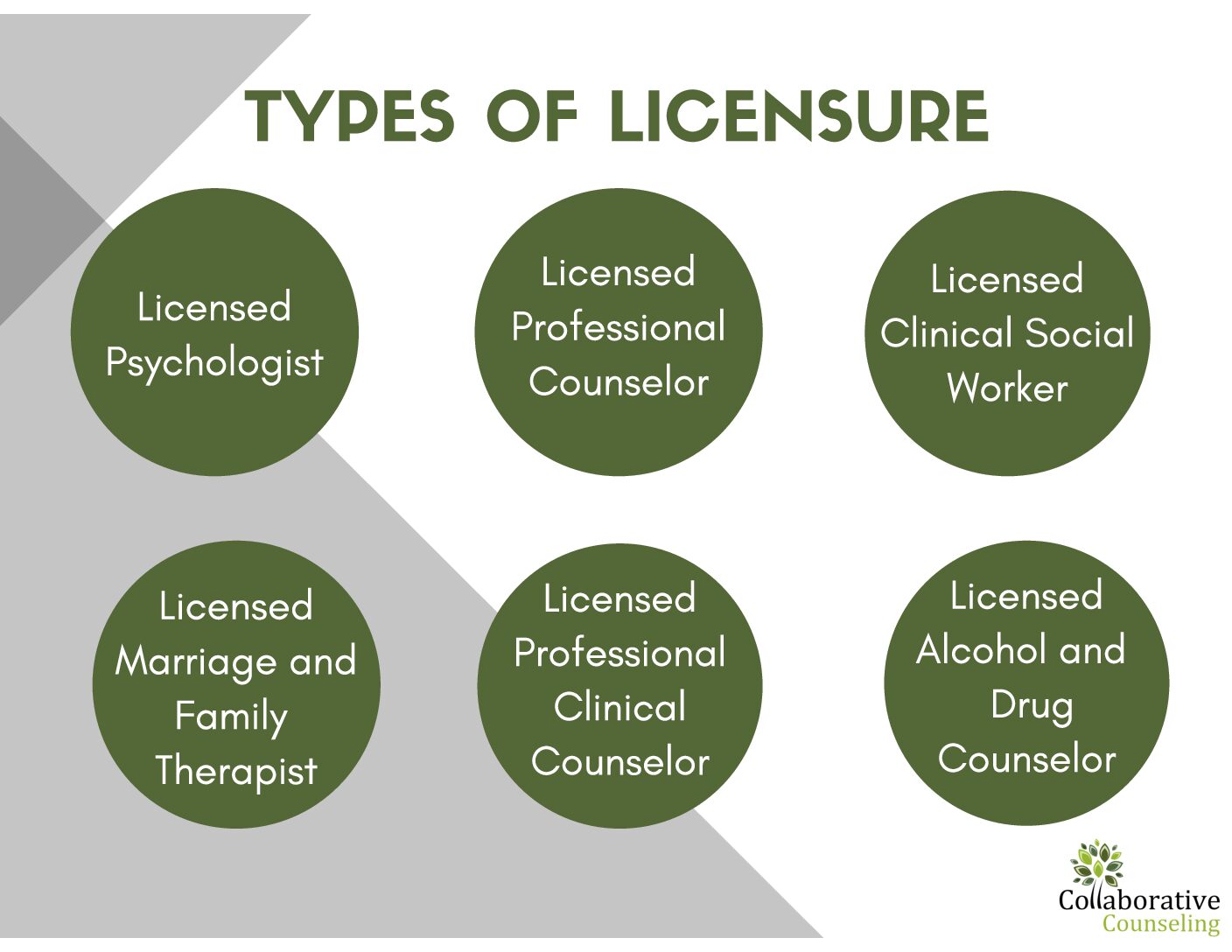
This article shares about types of licensure so you can understand the difference in types of therapists. There are several ways that one can pursue education in order to become a therapist. Understanding the differences in each licensure will help you understand how your therapist, or potential therapist is trained.

Here we will outline some of the most common licensures that our therapists have here at Collaborative Counseling.

Masters Degree

Above all else, a masters degree is required before obtaining licensure. Therapists can received a masters degree in many areas of study. These include psychology, social work, counseling, mental health counseling, marriage and family therapy, and many more.

It typically takes two years to complete a masters program. And requires completion of a four year degree.

Once a masters degree is obtained and before one can take the state or professional exam, several steps of provisional licensure and supervised counseling take place. When an applicate completes and passes this exam, they are a licensed therapist.

In the U.S., requirements for becoming a therapist are determined by state. As a result, the requirements vary depending where you live.

Types of licensure
Types of Licensure

Here are general descriptions and requirements of different licensure.

Licensed Psychologist (PhD, PsyD, or EdD)

Generally, you will need a doctoral degree to practice as a licensed psychologist. Doctorate programs are often the highest level of education in most fields. They take around four years to complete, after completing a bachelors degree. These psychologists have the ability to do psychological testing. In general, other licensed professionals cannot.

Licensed Professional Counselor (LPC)

Licensed Professional Counselors are masters level mental health providers. They require:

  • A minimum of 700 hours of supervised field experience in graduate school
  • Depending upon degree, 2,000-3,000 hours of post-graduate clinical supervision hours
  • Passing the credentialing exam

These professionals can work in a variety of settings, including communities and private practice. LPC’s work with individuals, families, couples and groups.

In Minnesota, LPC is not a common licensure, but Wisconsin uses these requirements for LPC’s.

Licensed Professional Clinical Counselor (LPCC)

Licensed Professional Clinical Counselors are also masters level professionals that have a masters degree in counseling or another related field. Some requirements for these counselors include:

  • an additional 2,000 post graduate supervision hours for licensure compared to LPC’s, for a total of 4,000 hours.
  • passing the credentialing exam

This is a more common licensure in Minnesota because this is the license insurance companies will reimburse.

LPCC providers can work in a variety of settings including private practice, residential facilities, community based agencies, schools and more! This licensure level is trained to offer therapy to individuals, couples, families, and groups.

Licensed Independent Clinical Social Worker (LICSW)

A Licensed Independent Clinical Social Worker is within the field of Social Work. These training programs focus on therapy from a perspective of the community that surrounds oneself.

To become a LICSW:

  • First, one must get their masters in social work (MSW)
  • After that you work towards licensure via clinical experience in and after graduate school.
  • After schooling comes a post graduate school experience. During this time social workers are supervised by a fully licensed person before receiving their own independent licensure.
  • Then they must take the state licensing exam.

Also, another variation of LICSW’s is a Licensed Clinical Social Worker (LCSW). This includes minor changes in requirements from state to state. For example, LCSW’s practice in Wisconsin, while LICSW’s practice in Minnesota.

A big benefit of this type of license is the type of insurance that LICSW’s and LCSW’s can accept. For example, they are able to accept Medicare if they choose to, while other licensed professionals do not have the option to accept this due to Medicare guidelines.

Licensed Marriage and Family Therapist (LMFT)

Licensed Marriage and Family therapists are another sub-sect of mental health providers that offer services to couples, families, and individuals. While LMFT’s do tend to work more in family and relationship settings, this is not the only population LMFT’s can work with.

Marriage and family graduate programs focus more on the family systems and relationships surrounding one’s life. This training informs and impacts the way LMFT’s approach therapy.

These therapists require:

  • 4,000 hours of post graduate supervised experience
  • Passing the national MFT exam.

LMFT’s can also work in private practice, community settings or residential facilities.

Licensed Alcohol and Drug Counselor (LADC)

Licensed Alcohol and Drug Counselors are master level professionals. They require:

  • Completion of 880 hours of supervised experience during the alcohol and drug graduate program
  • Candidates must pass the licensing exam

Having a variety of training programs for counseling helps keep our field diverse. It also helps provide a variety of specialties in our field. The vast array of services that are offered come from the differences in licensure. Providers with different licensure often focus their practice in certain specialties based on their degree and license.

However, a provider’s specific area of expertise could vary. It is best to schedule an appointment or meet a therapist personally to see if they are the best fit for you. We hope it helped to learn about the types of licensure of our providers.

For more information, call our office today to see who is available and may be a good fit for you! To learn more about our providers visit our website at https://www.collaborativemn.com/meet-our-team.

Read More
02

Levels of Mental Health Care

Posted by Collaborative Counseling
How to Successfully Co-parent with your Ex Partner and How it Benefits your Child

There are many different program options for addressing issues with mental health. It can be difficult to know which type would be the best fit for you or a loved one. We are going to try to break down the levels of mental health care to make it a little simpler!

Outpatient Options

In outpatient care, the patient goes to the place of service, gets said service, and then goes back home all in one day. There are four levels of outpatient care: 12-Step programs, routine outpatient programs, intensive outpatient programs, and partial hospitalization.

12-Step Programs

12 step level of mental health care

In a 12-Step program, participants typically meet on a weekly or monthly basis to talk in a group about shared struggles. People share their experiences and build a support community through those stories. Alcoholics Anonymous (AA) is one really common example of this type of service. Other subject areas include gambling, sex addition, eating disorders, and many more.

Routine Outpatient Care

Routine outpatient care is what we do here at Collaborative Counseling. In this level of mental health care, patients meet with a therapist in an office. Sessions typically last around an hour. Therapists will facilitate conversation to help with whatever may be happening in their life.

Intensive Outpatient Programs

outpatient level of mental health care

Intensive outpatient programs are similar to routine care in that the client goes to an office for services. However, these programs often involve both group therapy and individual therapy on a regular basis. The sessions are typically longer or occur more often.

Partial Hospitalization

Partial hospitalization (PHP) is one step higher in care. These programs are usually all day. The client would spend their day in different therapy sessions and/or programs and then go home for the night. There is more structure and help with basic care needs.

Inpatient Options

These levels of care take place in a hospital or residential setting. People typically check to a hospital or another facility where they spend the night. The two levels of inpatient care are: acute inpatient care and residential treatment.

Acute Inpatient Care

Acute inpatient care is a short term hospitalization. When care in an outpatient setting is not enough, clients can go to an inpatient facility. Facilities are staffed 24 hours a day by trained individuals monitoring client. The goal is usually to get the client stable enough to go back home.

Residential Treatment

Residential Treatment options last a bit longer than acute care. They take place in a home or apartment setting. There are still medically trained staff present, but they may not be monitoring the client as close as in a hospital. Clients work on building community in their living space while addressing their personal concerns.

No matter where you are at in your mental health journey, there are options for you! Hopefully this information helped clarify the levels of mental health care available.

Need help in finding programs near you? Click here.

Read More
23

Stressed? Take a Step Outside

Posted by Collaborative Counseling
yellow flowers with a view of mountains outside
Spending time outside can greatly reduce stress levels and improve physical health. #outdoors #healthyliving #mentalhealth

Life is stressful. For most people, the term ‘stressful’ is a major understatement to say the least. From work to studying to being home with kids or whatever your day consists of, it’s often tough to relax. Taking a moment out of your day to step outside and enjoy nature can ease some of that!

Here is a look into what happens in your body when you are in natural spaces:

  • Lowered cortisol levels – when your cortisol levels are constantly raging, like in periods of high stress, there is more risk for depression/anxiety, weight gain, trouble focusing, and issues with your heart
  • Lower blood pressure – the fresh air and view of nature help in keeping your heart and mind healthy
  • Better sleep – spending time outside helps people not only get a deeper sleep, but sleep longer through the night
  • Improved immune system – being outside exposes your body to a wide variety of healthy bacteria that work to improve your bodies natural defenses
  • Increased exercise – people are more likely to get moving when they spend time outside whether that is walking/biking/swimming/etc which is always great for you as a whole

There are many ways that immersing yourself in nature can get you that much needed break! Not sure where to start? Walk through a local park on your lunch break. Maybe go for a bike ride with a friend. Even having a view of natural environments or plants in your house can make a difference!

It’s time get serious about caring for the bodies we live in every day. Take that step outside and enjoy the warm summer weather that is just around the corner! (But don’t forget your sunscreen!)

Want to learn more? Click here.

Read More
02

The Power of Validation

Posted by Collaborative Counseling
Happiness

Validation is a powerful tool that can be implemented in almost every relationship we have. According to Karyn Hall, PhD: “Validation is the recognition and acceptance of another person’s thoughts, feelings, sensations, and behaviors as understandable. Self-validation is the recognition and acceptance of your own thoughts, feelings, sensations and behaviors as understandable.”

Why Do We Need Validation?

Validation is important for us to feel accepted by others. As most of us can attest to, feeling like you belong and matter is an important part of  feeling good about yourself. When we validate others, it brings us closer and strengthens the relationship. Additionally, validation helps us to build understanding with others and aids in effective communication. Validation also helps people feel important and cared for. This is especially true for kids who need validation to feel connected to their parents, express emotions and to develop a secure sense of self.

Levels of Validation

Marsha Linehan, PhD, has identified six different levels of validation and some tips on how to implement them.

  1. Being Present: giving your complete attention to the person struggling in a non-judgmental way
  2. Accurate Reflection: Summarize what the person has said, try to really understand and not judge the person’s experience
  3. Reading someone’s behavior and guessing what they may be thinking or feeling: pay attention to the person’s emotional state and label their emotion or infer how they may be feeling. Be sure to check in with the person to make sure your guess is accurate!
  4. Understanding someone’s behavior in terms of their history and biology: think about how someone’s past experiences may be affecting how they are feeling now, in this moment or situation.
  5. Normalizing or recognizing emotional reactions that anyone would have: recognize that many people may feel the way that you or the other person is feeling in a given situation and let them know that it’s okay to feel this way as many people do.
  6. Radical genuineness: this happens when you are able to understand how someone is feeling on a deeper, personal level. Perhaps, you have had a similar experience. Sharing that with the other person can help to validate their feelings and reactions.

Putting Words Into Action

Learning to validate others can be easier said than done. However, being more conscience of how our words affect others and even implementing the first few levels of validation can make a big difference in our relationships and interactions with others. An essential tenant of the therapeutic relationship is validation. It is important to know that we must first be able to validate ourselves before being able to validate others. Therapy can help you to achieve self-validation skills as well as learning skills to validate others. For more information about our clinicians and how they can help, visit: https://www.collaborativemn.com/meet-our-team.

Read More
13

Understanding Depression

Posted by Collaborative Counseling
Growing Plant Symbolizing Hope for Depression

There is a common misconception that depression is a choice. The truth is that depression is a common yet serious mood disorder that has to do with a chemical imbalance in the brain. People experience depression in a number of ways and symptoms can range from mild to severe. Depression can affect how someone feels and thinks as well their daily activities such as work and sleeping. There are a variety of factors that can put someone at-risk for developing depression such as:

  • Genetics: Depression can be hereditary and runs in families.
  • Environmental Factors: exposure to neglect, abuse and violence can be risk factors for depression.
  • Personality: Traits such as low self-esteem and being easily overwhelmed by stress can make people more vulnerable to depression.
  • Gender: Women are more likely than men to develop depression.

It should be noted that depression can look different for everyone. Some common symptoms of depression include.

  • Difficulty sleeping or sleeping too much
  • Loss of interest in hobbies/activities
  • Appetite or weight changes
  • Feeling hopeless
  • Trouble concentrating
  • Irritability

Treatments for Depression

There are several therapeutic treatment options for depression. Therapies such as cognitive behavioral therapy (CBT), mindfulness-based CBT and dialectical behavioral therapy (DBT) have all been shown to help reduce depressive symptoms and increasing coping skills.

Many courses of treatment for depression will include medications such as anti-depressants in combination with psychotherapy to treat depression. Remember, no two people are alike and therefore, neither are their treatments. What worked for one person may not work for you.

Additionally, activities such as yoga and exercise in general as well as meditation and healthy eating can all have an impact on our overall mood and help to decrease depressive symptoms.

If you are struggling with depression the first step is reaching out for help. Visit our website at: https://www.collaborativemn.com/  to learn more about the services we offer and the people who can help.

Read More
10

Tips for Going Back to School

Posted by Collaborative Counseling

Getting ready for and going back to school can be a very stressful time. Following the slower pace of summer, many struggle to get back into the mind frame to focus on learning and schoolwork.

Here are our favorite tips for parents to help prepare for the transition into a new school year.

Practice Getting Back on a Schedule

Take the week or two leading up to the first day to transition back to your school-year schedule and routines. In addition, work to get you and your kids back on the usual sleep schedule for school.

Take Care of Any Health Needs

If your child needs a physical, check up or needs medication refills make sure to follow up with appropriate health care providers. Also, try to be proactive in getting help for both physical and mental health needs your child may have going into this next school year.

Get Oriented

If your child is going to start in a new school this year spend time getting familiar with the space. Practice finding their classrooms, restrooms, the office or nurse and any other areas they need to be familiar with. The best way to ease anxiety about this first day of school is to help your child feel as prepared as possible.

Be Prepared for the First Day

To decrease the stress of the first day help or remind your child to pack their bag. Also, have them pick their outfit the day before. In addition, make sure to have healthy breakfast and snack foods available for your child.

All of these tips are aimed at helping your child to be successful on their first day of school. Anything you can do to decrease the stress and anxiety of the first day of school is recommended. Remember, anxiety is often just about the unknowns. Therefore, the more of those you can decrease the better off your child will be. Most of all, we want to send kids into the school year focusing on academics and of course, friendships!

Read More